
APOCALYPSE TV - A Review
A critical exegesis of a classic text

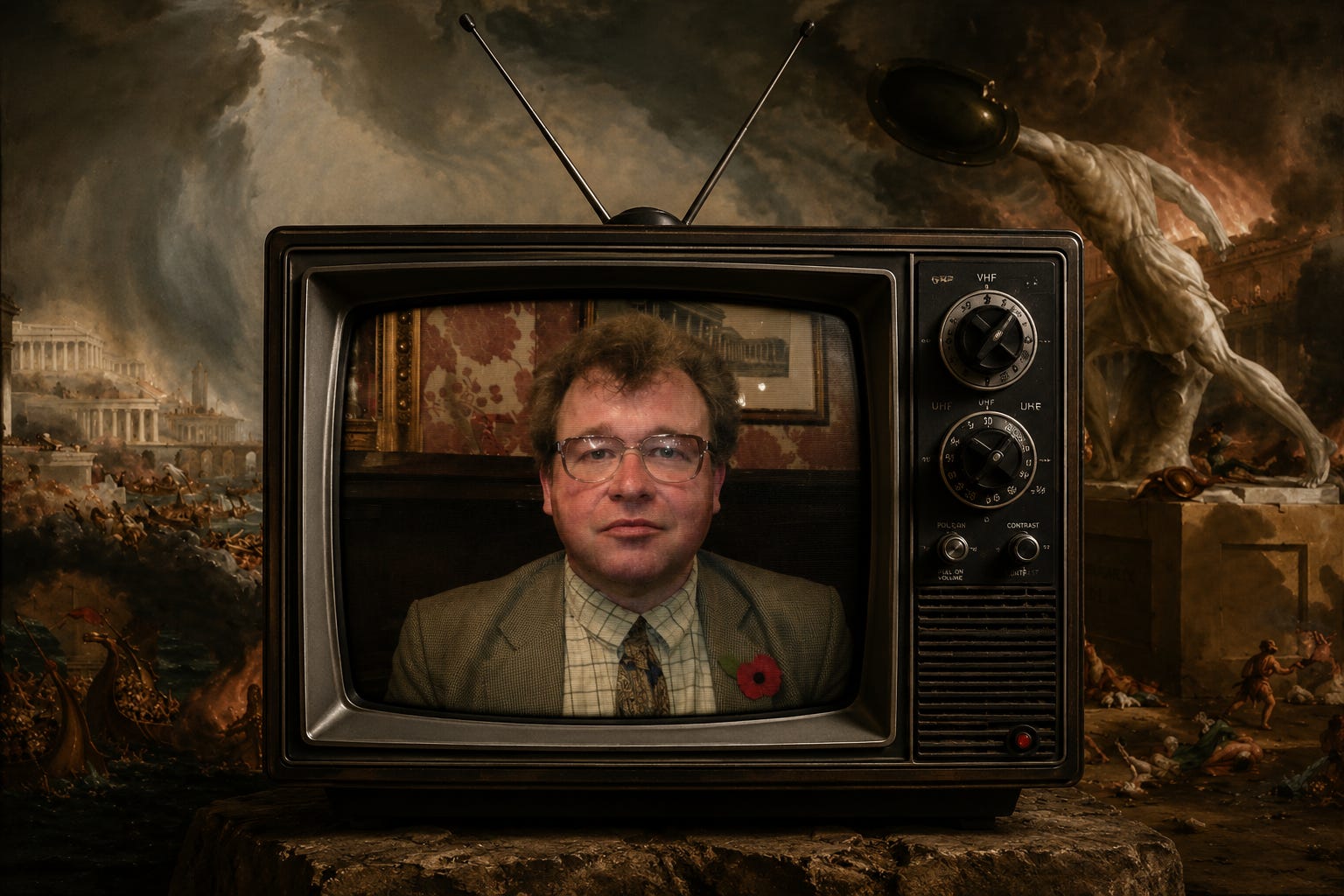
I’m often asked which of Jonathan Bowden’s many books I recommend. My answer used to be, “Whatever you can get your hands on.” Most of his early work, republished by Alex Kurtagić, is no longer available through online retailers, and the physical editions that remain are largely collections of his speeches, essays, and interviews. It is usually these collections, including Why I Am Not A Liberal and The Cultured Thug, that people are looking for. Now, however, I will always recommend Apocalypse TV: Philosophical Dialogues, a book he jokingly refers to as his ‘magnum opus’, a description I believe is entirely deserved.1
Bowden’s prose has a reputation for being simultaneously turgid and rhapsodic, often sprawling beyond the limits of any obvious structure. A.E. Housman’s judgement on Swinburne’s lyric poetry could almost have been written for much of Bowden’s prose work: “There is no reason why they should begin where they do or end where they do; there is no reason why the middle should be in the middle; there is hardly a reason why, having once begun, they should ever end at all.”2 Apocalypse TV avoids these faults, partly because the dialogue form acts as a check on his rhetorical exuberance, allowing him to reconsider an idea, qualify a proposition, and test it through an exchange between two contrasting archetypal voices.
The two characters are named Jonathan and Samuel, though they refer to each other as Frederick and Thomas. In his own review of the book, Bowden explains that they are “obvious stand-ins for Nietzsche and Thomas Aquinas.”3 It’s no coincidence the traditional Catholic is given an Old Testament name: in the second chapter they debate the Jewish provenance of Christianity and of its relationship to the decline of the West, but Bowden delays a revelation until the final chapter, where he discloses that Samuel’s full name is Dr Samuel Meyer. Jonathan is unmistakably Bowden’s own voice, yet there is also something of the reactionary traditionalist within him, perhaps inherited from his tory father. He once said “There’s a northern streak to me. I’m very direct for a southerner. I come straight out with it, which is slightly odd. And maybe it’s my mother, because my mother had two personalities.”4 He was a combination of conflicting tendencies, radical modernist and traditionalist, revolutionary and conservative, and it makes him ideally suited to the dialogue form.
Since Edward Dutton’s 2025 biography Shaman of the Radical Right, Bowden’s reputation has been complicated by accusations that he embellished or fabricated aspects of his own life, yet whatever disputes surround his personal mythology, no such evasions are apparent in this work.5 He is brutally honest and direct, but as an artist he uses the mask to tell the deeper truths, and he revels in the theatricality of the puppet show. Outside of his film Grand Guignol, and his speech on the subject, it is as close as we will get to his own rendition of a Punch and Judy act. It is precisely this ventilation of repressed truths through artistic performance that runs like a golden thread through his political and cultural speeches; if Bowden can be said to have a philosophy of his own, it begins here. The book is thick-laden with subversive wit and a love for epigrammatic paradox which brings to mind Wilde’s dialogues more than Plato’s. Bowden declared “It is the nearest thing you will ever get to the debates between the Philosophers in Ancient Greece — yet it hails from a primordial standpoint.”6 But don’t expect a carefully reasoned philosophy, this is a polemic on cultural matters, often of the most obscure and taboo subjects. Troy Southgate comes closer to describing the experience of reading it:
“‘Apocalypse TV’ is like spending several hours sitting in a room with Jonathan Bowden and his Christian alter-ego.”7
Apocalypse TV is essentially a written speech. Anyone familiar with Bowden’s oratory will recognise this immediately, it is exactly how one imagines he would write. Unlike much of his other prose, it is eminently quotable, and this review is intended as a showcase for some of the finest passages from each of the six chapters, though I could easily have chosen many more. Although he wrote it in 1997, in the aftermath of Tony Blair’s election victory, it was not published until 2007, after Bowden resigned from the BNP and declared: “I shall devote myself to the world of the arts from which I originate and to which I shall return.”8 As we shall see, Apocalypse TV is both a snapshot of the cultural anxieties of the late 1990s and a remarkably prophetic work whose insights seem more relevant now than ever. Bowden was a man of apocalyptic extremes and he speaks to us because we live in extreme times. The 1990s now appear almost placid in retrospect, yet he sensed the destructive energies lying dormant beneath the surface of society, waiting to awaken in the decades that followed.
The first chapter is titled SEX, DEATH, FRED AND ROSE WEST, and is primarily a critique of the liberal understanding of sex and morality. The two characters are initialised as S and J, and I shall refer to them in the same way throughout this review. S points to a central liberal paradox, that acceptable behaviour must be based on a form of choice called consent (a “magic line”) while humans are simultaneously understood to be products of circumstance and environment.9
“Choice is good of itself as the act of an autonomous agent - who instantly ceases to be autonomous when he does something liberals or society at large find offensive! Their attitude is thoroughly paradoxical.”10
J replies that morality is relative, and from a liberal perspective the position is perfectly coherent. The mistake is to judge it by an absolute standard that they do not believe in themselves. The argument has obvious contemporary echoes, such as the attempts to restrict children’s access to social media while simultaneously extending them the right to vote. The discussion culminates in one of the book’s central declarations, where J lays his philosophical cards on the table:
“In my perspective, my dear chap, you cannot have civilization without barbarism. Barbarism is necessary for civilization. You cannot create great art without it - and art is the highest value in a society without God.”11
The next liberal idol Bowden takes the hammer to is the pornographic industry. J argues that men who consume porn are exploited victims of an industry that reduces sexuality to another branch of mass production:
“A lot in this society is standardised, mechanised, just so many units of production and consumption. The pornographic industry is a part of that cycle. It’s almost the sexual equivalent of the ball bearing industry.”12
When S pivots him back from this curiously socialist sounding remark to consider the “individual need” J answers by returning to one of the book’s central themes: the necessity of artistic and spiritual creation in modern society.
“The great sadness which the pornographic industry feeds off, in both women and men - men and women who are trapped in the body, who can’t go beyond the body, into their own minds, into culture, into language, into the use of their intellects and spiritual faculties to create.”13
The discussion then turns to what Bowden sees as the naïve optimism and snobbery underlying liberal anthropology. He likens the liberal faith in human perfectibility to the Pelagian belief that man is naturally good, illustrating the point through the case of the liberal novelist C. P. Snow:
“Snow is saying, in effect, that if everyone were a don, if every one were a scientist like him, if everyone had civilized and creative lives, perhaps the law would never need to coerce, and everyone would obey it instinctively. But, of course, life is not like that, and not everyone, thank goodness, is like C.P. Snow.”14
J ironically likens the inner lives of these “luvvies” to the serial killer Fred West who was introduced at the start of the book as an emblem of liberal society’s deepest horror. He concludes with one of the chapter’s sharpest aphorisms:
“It is often the ones in society who affect the softest values, who also have the hardest hearts.”15
Chapter 2 is perhaps controversially titled HITLER WAS A FEDERALIST! The conversation takes place in the lobby of a comfortable hotel with the two musing on the nature of liberalism over the sounds of a symphony orchestra playing Beatles muzak, which is intended to be symbolic of the dumbed down domestication of high culture.
“S: What our views have in common is the idea that this is a mediocre society, without a profound view of itself.
J: Yes, in which even so-called ‘high’ art does not deal with the most profound issues of human life and destiny. Everything has been flattened out: it’s the religion of the small man, the war of the small man.”16
The question of religion brings them on to their disagreements, whether liberalism is endemic to Christianity or a move away from a true understanding of it. This discussion is very familiar to anyone on the right-wing so I will spare the quotes but it is funny to see Bowden parody it. He clearly delights in staging the argument, and one can almost hear the relish with which he wrote the exchange. They agree to return to the question of the mediocrity of modern liberal society:
J: For most people, their ideology is neutrality: the safety of the bank clerk, the safety of the man in the middle. Of course, the minute people start really believing in things, and rejecting other things, you have division, factions, mutual distrust -
S: One of the main things liberal society cannot tolerate - the absence of concord.”17
This leads him to recollect the time he was kicked out of a London intellectual salon for saying he didn’t care about what was happening in Bosnia.
“J: Monsieur G was apoplectic. What did he say? ‘I was in the war, you know, and I killed many people; if I had a gun I’d shoot you now’.”18
This episode may well be autobiographical. Bowden frequently mentioned attending London intellectual salons in his speeches and interviews, and “Monsieur G” is almost certainly Jean Gimpel, whose The Cult of Art he cites elsewhere in his work. He notes with satisfaction that his expulsion places him in the company of the outsider artist Albert Louden, who was allegedly excluded for having “‘a thuggish face’. The implication being that he was too working class for a salon in Chelsea.”19 True or not it illustrates his fascination with the figure of the cultured outsider.
The discussion then turns to the possibility that liberalism may ultimately collapse under the weight of its own contradictions. Artificial political structures cannot indefinitely suppress human nature; sooner or later, bread and circuses give way to “meat and warfare”.20
“J: Concord and harmony, such as there is at the moment - itself debatable - only ever exists among peoples who are declining, and who need to huddle together for mutual protection.
S: Well, the federalists in Britain do, it is true, appeal regularly to Britain’s decline, her loss of Empire, and so on, to support their project. What other place can Britain have in the world if not as part of such a powerful bloc as the EU? This is their claim, at least.”21
From this follows a bizarre discussion of the necessity of European leaders to integrate politically incorrect aspects of European history, including Adolf Hitler, into their self-conception.
“J: This idea of ‘the end of history’ - remember Fukuyama’s book - seems to be casting its shadow over politics and society. Everything can be brought in, harmonised with everything else in larger and larger systems. It’s almost a Hindu way of thinking! Even the demons can come in from the cold.”22
Today this feels unmistakably of its moment, but ‘the end of history’ was itself a sort of recapitulation of James Burnham’s much older thesis in the Managerial Revolution, which incorporated Hitler into a broader historical analysis without treating him as an inexplicable moral aberration.
His closing comment would apply better to other elements that Europe has ingested in the last thirty years:
“J: It may collapse through not being able to ingest this sort of material. Maybe, in the end, there is meat that is just a bit too strong, too raw and bloody. They may well choke on it.”23
Chapter 3 ROOM 101, DOWNING STREET, takes us to a park in central London where Bowden’s two “puppets”, as he calls them in his own review of the book, discuss one of his favourite novels, Nineteen Eighty-Four, and its relevance to Tony Blair’s recent election victory.
“S: I knew that nothing had changed, everything would remain the same. One set of middle managers replaced by another set. I thought of Orwell’s book - Eastasia, Eurasia, who were Oceania at war with? It didn’t matter. Who was ruling them? Identities didn’t matter - just the Party. And so it seems here and now: one big party, Tory, Labour, Liberal Democrat - it’s all the same. And the electorate know it.”24
As throughout the book, Bowden uses a familiar cultural reference as a springboard into a broader critique of liberal society. From Orwell the discussion moves naturally to censorship, and the brief intellectual thaw period in the 1990s, when books such as the Bell Curve could find mainstream publishers. He contrasts this with the case of Chris Brand, whose The G Factor, he notes, “was dropped by the publisher and still hasn’t been published, and which led to Brand’s being virtually ostracized at his own university.”25 J then observes an ironic reversal in the boundaries of acceptable opinion, whereas in the 1860s and 1870s “virtually no intellectual discussion of sexuality was possible”, one could speak freely about race; but today the opposite is true.26
One of the great strengths of Apocalypse TV is the range of obscure cultural episodes Bowden draws into the conversation. One example is the Helen Demidenko affair, of which I was completely unaware (not to sound like Ron Unz).27 Her novel The Hand That Signed the Paper, which dealt with Ukrainian participation in the persecution of Jews in World War II, won several major literary awards before becoming engulfed in controversy. Critics attacked both Demidenko’s public comments on Ukrainian moral responsibility and later revelations concerning her own identity when her real name was revealed to be Helen Dale. This kind of cancellation has become commonplace now but to Bowden, writing in 1997, it was a harbinger of liberalism’s future, a society that practises censorship while claiming to oppose it. He was fascinated by this contradiction and determined to expose its irony:
“S: Most censorship in our society is, in fact, self-censorship. No one passes an edict, unlike Nazi Germany where there were public book burnings and everyone was invited along to watch.
J: Or like the Soviet Union, where a certain proportion of books were taken to a secret annex of the Moscow Central Library, and stored there. You had this amazing mishmash of Playboy magazine next to Solzhenitsyn, highbrow banned books next to trash which ‘corrupted’ public morals.
S: Well, they got that last bit right!”28
The dialogue anticipates what we would today call Woke Capital:
“J: You also have the phenomenon where enormous capitalist monopolies and multinationals are adopting left-wing views - synthetic, standardised, politically correct gestures. … corporations are adopting synthetic liberal positions in order to neutralise all hostility: environmental destruction, much of which multinationals contribute to themselves, endangered species, pollution, racial division – all of it grist for the capitalist mill. The system contains all contradictions within itself.”29
His final observation in this chapter is that liberalism survives by feeding on the intellectual torpor of the masses:
“It goes with the sort of mental sleep in which most people spend their lives, at least in prosperous and technologically advanced countries.”30
Readers interested in this aspect of Bowden’s thought should also seek out his lecture on Nineteen Eighty-Four, where many of these themes are developed at greater length.31
Chapter 4, ALIEN NATION, takes place in a cafe in York. Here Bowden turns to more explicitly apocalyptic themes: pandemics, environmental destruction, urban decay, economic collapse, HIV/AIDS, and the wider catalogue of disasters that populate the modern imagination. Reading this chapter now, it is impossible not to wish Bowden had lived long enough to give his thoughts on Covid. He argues that such apocalyptic narratives in the media serve a psychological function: they satisfy a public desire to feel threatened and energised in a world from which traditional religious frameworks have disappeared.
“J: But they don’t want too much risk. They don’t want too much violence, or danger, or pain, but they are hunting for some sort of prospect of destruction, some sort of manageable risk.
S: Naturally, when you stop believing in Hell - the real risk of endless destruction and pain - you look for a surrogate, though one you can cope with. Or maybe one you cannot cope with, if society takes its death wish to the ultimate conclusion to which it leads.”32
This echoes Burke’s conception of the sublime, the human attraction to experiences of terror and magnitude when encountered from a position of safety. The discussion then takes a strange detour into the possible overlap between right-wing politics and environmentalism, before the dialogue turns in on itself:
“S: We’re getting a bit self-reflexive. Should this be in the dialogue?
J: But I believe in self-reflexiveness in all things, including my monologues, and our dialogues.
S: Now you’re being self-reflexive about your self-reflexiveness. Should that also be in the dialogue? We’re in danger of entering an endless loop.”33
The joy of experiencing the banter throughout with his voice in your head is difficult to express, I urge you to read it for yourself if you get a kick out of Bowden’s eccentric humour. The theatrical structure of the dialogue allows the conversation to keep moving when the collision of ideas threatens to disappear into abstraction, which leads the discussion to deepen into an exploration of J’s metaphysical beliefs.
“I believe in an endless succession of Big Crunches. Disaster will happen, but we will go on.”34
Also worth highlighting is Bowden’s argument that drug use represents an attempt by the uncreative to artificially simulate a state of mind that the true artist reaches naturally.
“J: For the truly creative person drugs are unnecessary, if not a positive hindrance, whilst for the uncreative person they are pointless, and will never supply their creative lack.
S: So drugs have a certain kind of immorality about them on your perspective as well, don’t they? Drug-taking is at least in some cases a kind of ‘sin’ against creativity.
J: Yes, in a very attenuated sense of ‘sin’, old man.”35
I could have included dozens of other passages from this chapter, but the ones that demand most attention concern the internet.
“J: Because of the Internet it is now virtually impossible to keep many once-forbidden ideas from mass circulation. In that sense the playing field has changed greatly.”36
Yet he also anticipated the counter-movement that would follow:
“S: More and more of the Internet will be ‘tamed’ and domesticated, sanitized and filtered. And we may end up back where we were before it came on the scene.”37
This is a strikingly prophetic prediction considering it was written in 1997. Part of Bowden’s wisdom is in recognising that every energy has a double aspect: creation and destruction.
Chapter 5, ART ATTACK, takes place in a park near a London gallery, where J and S discuss recent exhibitions they have visited. The chapter contains one of the book’s funniest passages, Bowden’s attack on Tracey Emin and her notorious installation Everyone I Have Ever Slept With 1963–1995, which J suggests should have resulted in her arrest.
“J: Pornographic artistes like Sarah Young make videos of themselves having sex with twenty men at once, so Tracey’s tent is hardly a novel contribution. She just stitched up a tent to say the same thing.
S: Ah, a tent you have to enter into in order to read little stories about her bed partners and her aborted unborn child. What an unsubtle concept: Tracey’s patchwork womb.”38
Picking up on a recurrent theme in his work, Bowden argues that modernity has failed to realise its own possibilities. He laments that television “could be an extraordinary art from - it should be total art, sound, imagery, movement - and yet look how poor most television is.”39 His comments on ‘cyber-art’ could apply almost unchanged to the current debate surrounding AI generated art:
“In the right hands cyber-art could also be extraordinary, but I doubt whether any minds currently at work, and which could make something aesthetic out of cybertechnology, are even interested in it.”40
This chapter is the most surreal in the book. It seems that Bowden wanted his discussion of art and his aesthetics to be a work of art in itself, or an example of his own peculiar artistic philosophy in practice. In the course of this exchange he produces the following line:
“Ah, so that’s where the missing genitals went”41
I will leave it to you to discover the context for yourself.
The final chapter SPEAK NOW OR FOREVER HOLD YOUR PC, set in a coach bound for Edinburgh, turns the banter to full volume. It’s the funniest chapter and serves as a reflection on the themes explored throughout. Bowden manages to accurately describe the oddities of our age in a style few, if any, other writers could match:
“J: Maybe there’s a subconscious attempt on the part of many people, at the end of the millennium, to revert to the lowest forms of life, behaving like insects and amoebae, reproducing asexually, pleasuring themselves in their multimedia sex-cocoons, like Japanese newly-weds.”42
He does an imitation of Bill Clinton with his secretary under the table, which I suspect would work better in performance than on the page:
“Hey Hillary, hey there darlin’, fetch me them budget papers while...oh, Jessie-Mae, oh, don’t stop, oh Hillary, can you check whether...oh Jessie-Mae, yeah, I like it like that, you’re fantastic, babes...your kneepads, darlin’...OJ...balance mah budget...hell of a way to eat a tortilla...mmmmmmm....”43
At this point in the book Bowden is having a lot of fun. But he’s also trying to be outrageous and politically incorrect, partly because, well, because it is fun, but also because he’s leading by example, pushing against the restrictions he has spent much of the book criticising. When S raises the subject of disability rights, J doesn’t miss the opportunity to be outrageous:
“The fact is, I do not go all gooey-eyed when the Elephant Man turns up on my doorstep.”44
S responds by identifying the broader issue:
“Political correctness has brought us to the point where you can talk about anything trivial until the cows come home, but if it’s serious, potentially divisive, ideological, then no, sweep it under the carpet.”45
This is the purpose of Apocalypse TV. It is an attempt to seriously examine subjects that Bowden believed the mainstream media avoided precisely because they were controversial or ideologically inconvenient. As J puts it:
“J: What they’re really interested in is Gazza and Ginger Spice!
S: You have injected some more soon-to-be-meaningless references in what is supposed to be a timeless piece of literature by us.”46
Bowden’s review, which I believe was written in 2010, recommended swapping out all these names with contemporary equivalents and the point would remain true. His impression of “a lisping David Attenborough” will probably have a longer comedic half-life.47 He jokes that it makes sense Blair declared his favourite novel to be Ivanhoe because he “would enjoy reading about knights jousting over fair maidens given that he has to look at Cherie over the breakfast table every morning.”48 When S questions whether to put that in the book J responds that “the only way we’ll have a chance is if we make this book the moral equivalent of heroin.” By which he meant “dangerous and addictive.”49 I should add that although there are some things covered in this book that I haven’t touched for hygienic reasons, it is safe to read, mandatory in fact.
The chapter includes a discussion of Critical Race Theory which prefigures later debates around wokeness:
“There has also been a more extreme but less successful version of PC - Critical Race Theory. It’s one step beyond PC, and aims at banning all texts containing generic references to classes of human beings, whether racial, sexual, religious, political, whatever. But ‘mainstream’ PC intellectuals want nothing to do with it.”50
S points out that even the term ‘sexual politics’ is a politically correct formulation: “As if sex was really a matter of power rather than morality.”51 J then deconstructs it further, exploring the origins and reappropriation of several PC terms. S concludes with a final condemnation of liberalism:
“Liberalism is a velvet glove which contains an iron fist. Thought crimes are essential to liberal thinking, which like any ideology wants people to think a certain way, and stigmatizes them for not doing so.”52
Bowden believed liberalism was heading for collapse under the weight of its own contradictions, but Apocalypse TV is not merely an observation of that collapse, it is intended as an artistic intervention. As he put it in his Heidegger speech: “There’s ruins around you, so you give them a bit of a push.”53
Jonathan Bowden, Apocalypse TV: Philosophical Dialogues. The Spinning Top Club, 2007. p. 211. Available at: https://jonathanbowden.org/wp-content/uploads/2023/03/2007_Apocalypse-TV.pdf
A. E. Housman “Swinburne.” Collected Poems and Selected Prose. Penguin Books, 1988. p. 294. Available at: https://papyrocentricperformativity.wordpress.com/poems-and-brickbats/
Jonathan Bowden (writing as John Michael McCloughlin): “Jonathan Bowden’s Apocalypse TV.” Jonathan Bowden Archive, 2010. Available at: https://jonathanbowden.org/articles_reviews/jonathan-bowdens-apocalypse-tv/
Jonathan Bowden, Q & A on Renewing the Radical Right, Why Bowden Was Not a Conservative, and Other Topics. 24th New Right Meeting, November 21, 2009. Available at: https://jonathanbowden.org/speeches/q-a-on-renewing-the-radical-right-why-bowden-was-not-a-conservative-and-other-topics/
Edward Dutton, Shaman of the Radical Right: The Life and Times of Jonathan Bowden. Imperium Press, 2025.
Jonathan Bowden (as McCloughlin), “Jonathan Bowden’s Apocalypse TV.”

Bowden's resignation letter https://lancasteruaf.blogspot.com/2007/07/bnps-cultural-officer-resigns-after.html
Apocalypse TV. p. 6.
Ibid. p. 9.
Ibid.
Ibid. p. 34.
Ibid. p. 35
Ibid. p. 41.
Ibid.
Ibid. p. 55.
Ibid. p. 58.
Ibid. p. 59.
Ibid. p. 60.
Ibid. p. 64.
Ibid. p. 66.
Ibid. p. 67.
Ibid. p. 68.
Ibid. p. 70.
Ibid. p. 85.
Ibid. p. 86.
Ibid. pp 81-86.
Ibid. pp. 87-88.
Ibid. p. 106.
Ibid. p. 117.
Jonathan Bowden, The Totalitarian Politics of George Orwell’s Nineteen Eighty-Four. 23rd New Right Meeting, London, September 26, 2009 https://jonathanbowden.org/speeches/george-orwells-nineteen-eighty-four/
Apocalypse TV. p. 128.
Ibid. p. 146.
Ibid. p. 149.
Ibid. p. 153.
Ibid. p. 164.
Ibid.
Ibid. p. 176.
Ibid. p. 196.
Ibid.
Ibid. p. 187.
Ibid. p. 205.
Ibid. p. 207.
Ibid. p. 209.
Ibid.
Ibid. p. 210.
Ibid. p. 217.
Ibid. p. 218.
Ibid.
Ibid. p. 221.
Ibid. p. 225.
Ibid. p. 231.
Jonathan Bowden, Martin Heidegger and Death’s Ontology. 6th New Right meeting, London, February 18, 2006 https://jonathanbowden.org/speeches/martin-heidegger-deaths-ontology/
My favourite Bowden book, besides all the politics and stances, it's entertaining to read the conversation that Bowden is basically having with himself, many predictions became true.
Jonathan speaks from the grave.